Sale and purchase volume held up across the tanker and dry bulk sectors, with modern tonnage commanding firm prices while recycling stayed quiet through the early monsoon.
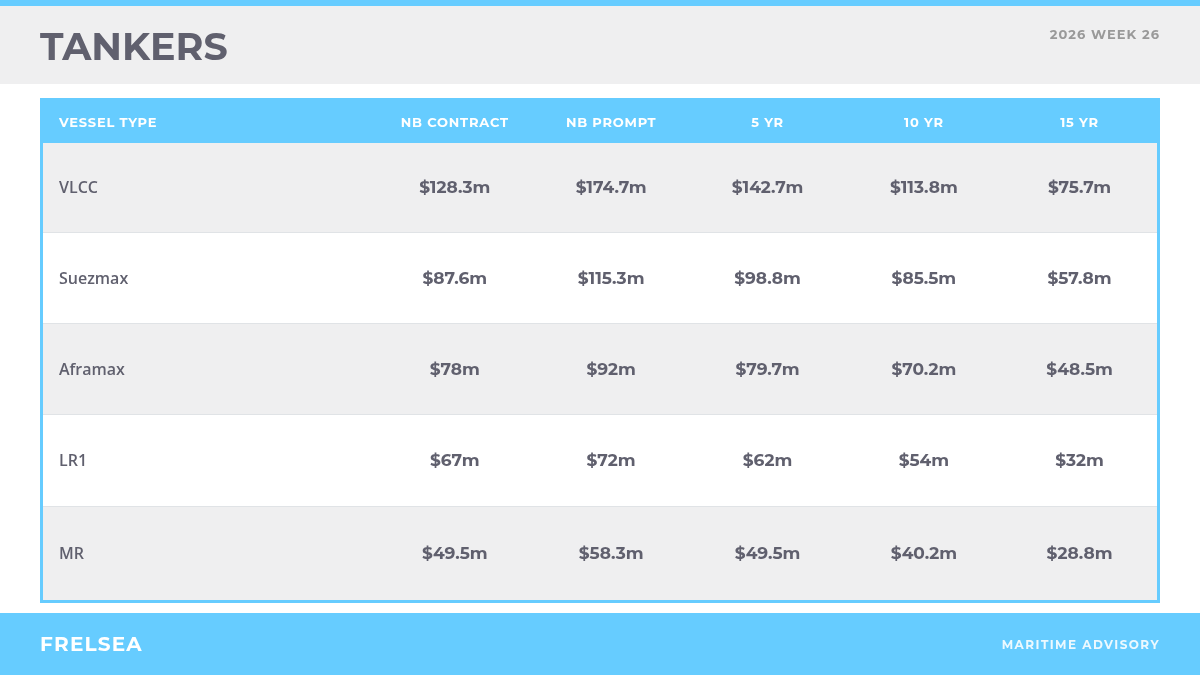
The crude and product sale and purchase market recorded steady rather than heavy volume. On the largest sizes, the C. Innovator, a 314,000 dwt unit built in 2012 at Dalian, sold at USD 52 million with a scrubber fitted and a time charter to Mercuria attached at around USD 28,000 per day running to a maximum of October 2027. The older Eclat, a 299,000 dwt vessel built in 2004 in Japan, changed hands at USD 50 million. Both sales reflect continued appetite for large crude tonnage able to trade in the current freight environment.
Activity concentrated in the MR segment. The 2026-delivery resales Weco Isabella and Weco Twiggy, each 49,500 dwt and built at Penglai Jinglu with scrubbers fitted, were committed at USD 56 million each, a level that captures the premium buyers will pay for prompt modern product tonnage. The Xing Tong 799, a 50,000 dwt vessel built in 2011 at Onomichi, sold at USD 27.5 million basis charter-free delivery in late September. The 2009-built Dylan, a 50,000 dwt epoxy-coated unit from a Chinese yard, was committed at USD 20.9 million. At the vintage end, the 2002-built Korean sisters Lanikai and Caroline reported en bloc to Chinese buyers, with price indications diverging sharply across reporting sources and warranting confirmation before the level is treated as firm.
Newbuilding ordering for large crude carriers continued at pace. Very large crude carrier contracts were placed at Chinese and Philippine yards at prices of around USD 125 to 130 million each for deliveries in 2028 and 2029, extending a record run of ordering in the segment through the first half of the year.
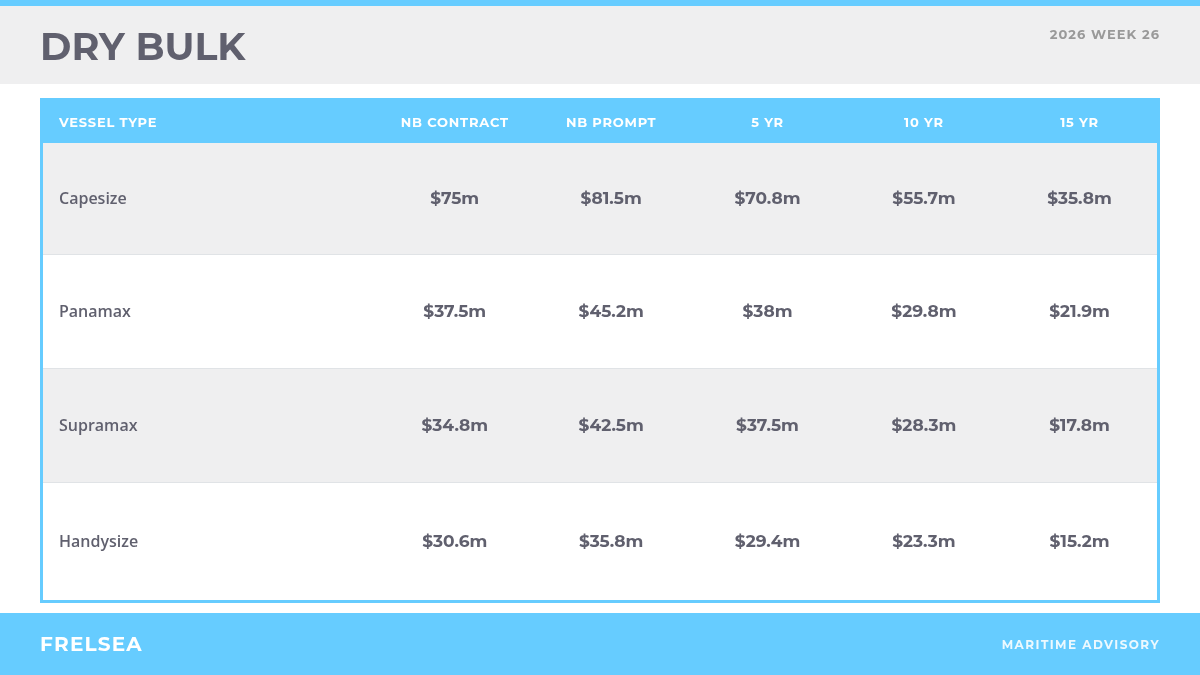
Trading spread evenly across the size range. In the Kamsarmax sector, the Etron, an 81,000 dwt vessel built in 2016 in China, was committed to Agricore at USD 27 million, while the modern Rostrum Stoic, an 82,000 dwt unit delivered in 2023, achieved USD 37.2 million, a spread that illustrates the premium attached to recent eco tonnage. On the Ultramax, the Ultra Saka, a 63,500 dwt vessel built in 2013 in China, sold at USD 23.2 million, with the sellers having acquired her in January at USD 20.5 million.
Supramax sales covered a wide age band. The Unity Maria, a 55,700 dwt Korean-built vessel from 2012, sold at USD 16.5 million, and the 2010-built St Paul, a 58,000 dwt unit, achieved USD 16.8 million. The 2002-built pair VW Trust and Grace Bali, each around 52,500 dwt, changed hands at USD 8 million and USD 8.8 million respectively.
Handysize demand remained firm for modern Japanese tonnage. The Darya Krishna, a 34,900 dwt vessel built in 2016 with box-shaped holds and freshly passed surveys, sold at USD 20 million. The Astro Propus, a 38,300 dwt unit built in 2014, went to Devbulk at USD 19 million with the balance of a Cargill charter attached. Further down the age curve, the Maple Marina, a 37,200 dwt Korean-built vessel from 2012, sold at USD 14.3 million, the 2009-built Scio Spirit at USD 14 million, and the ice-classed Suzanna D, a 2012-built unit, at USD 12.6 million. The smaller Devbulk Imabari, a 29,500 dwt vessel built in 2009, went to Turkish buyers at USD 10.5 million. Newbuilding interest in the sector held, with Kamsarmax contracts at Chinese yards reported around USD 40 million.
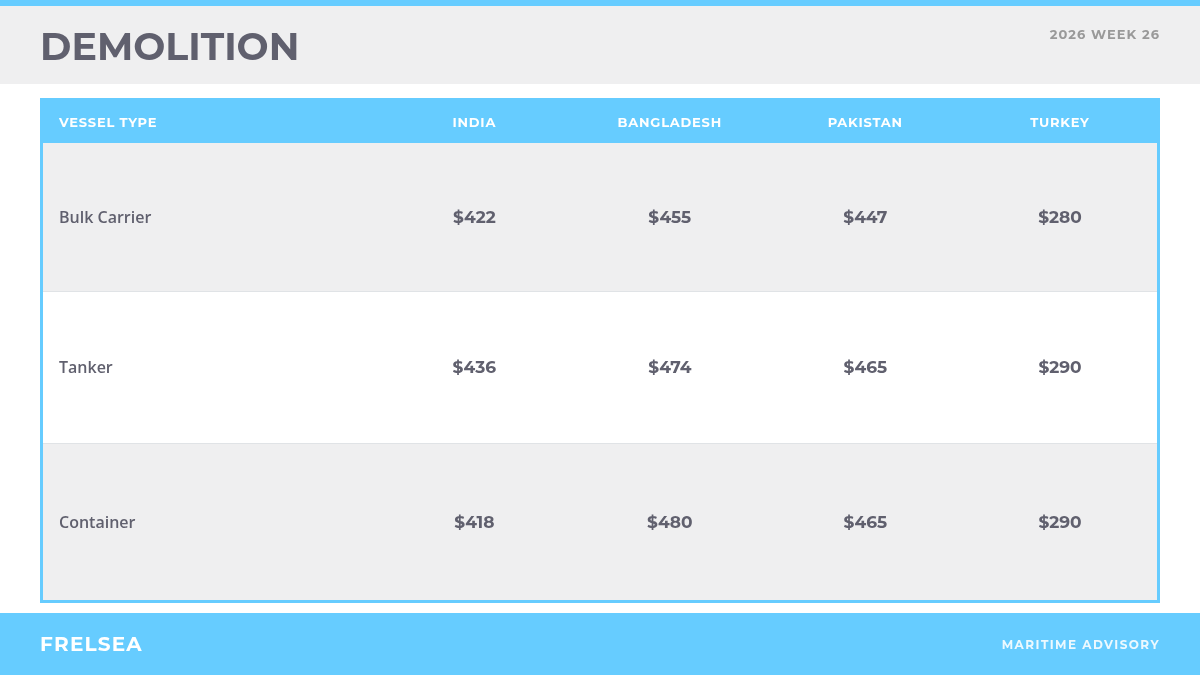
The recycling market stayed subdued as the monsoon set in across the subcontinent. Dry cargo prices settled at around USD 420 per LDT in India, USD 455 per LDT in Bangladesh, and USD 447 per LDT in Pakistan, with tanker units carrying a modest premium to those levels. Turkey held near USD 280 per LDT and remained structurally uncompetitive for mainstream international tonnage. Local currencies and steel plate prices were broadly stable, and buying interest stayed firm against a thin supply of genuine recycling candidates.
Sales were limited. The Wantong 497, a 1986-built small bulk carrier, sold at USD 468 per LDT for delivery to Bangladesh, and the 1995-built general cargo vessel Neptune Starlight was committed to Bangladesh at an undisclosed level. Tanker recycling volumes stayed exceptionally low through the first half of the year, well below the equivalent period of 2025, as strong freight earnings kept older units trading rather than heading to the beaches.