Secondhand demand held firm across tankers and dry bulk this week, with a return of Capesize activity, a deep run of Supramax and Handysize sales, and a heavy newbuilding slate set against a subcontinent recycling market still finding direction.
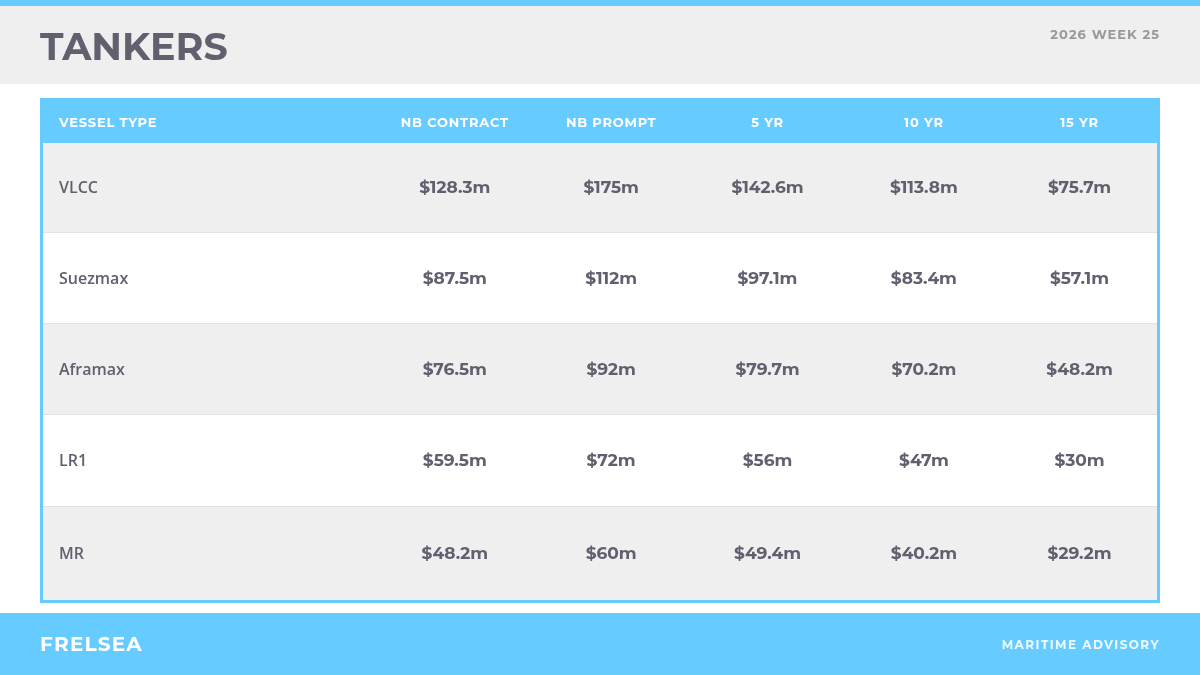
The crude sector produced the week’s headline tanker sales. A 2008-built VLCC of around 314,000 dwt, scrubber fitted, sold at 79 million dollars, with the seller having bought the vessel just over a year earlier at 40 million dollars. A 2006-built VLCC of about 302,000 dwt changed hands in the low 60 million dollar range. In the Suezmax size, a 2007-built unit of around 159,000 dwt was committed at 50 million dollars for prompt delivery in the Arabian Gulf, the seller again realising a sharp gain on a purchase made late last year at 37.5 million dollars.
Product tonnage stayed in demand. A 2015-built coated LR2 of about 110,000 dwt was sold to Indian buyers at 72 million dollars, and an older MR of around 51,000 dwt built in 2007 went to Middle Eastern interests at 20 million dollars. Smaller gas tonnage also traded, with a 2014-built 5,000 cubic metre pressurised LPG carrier sold to Cypriot buyers at 14.3 million dollars and a 2009-built LNG carrier of about 91,000 dwt going to Indonesian interests at 65 million dollars.
Newbuilding ordering in the tanker segments remained heavy. One Korean owner booked four VLCCs of around 320,000 dwt at 131 million dollars each for delivery through 2030, while another contracted four 300,000 dwt units at 130 million dollars each. MR ordering continued at yards in Korea, with prices for 50,000 dwt units around 53 million dollars and two separate two-ship orders placed during the week.
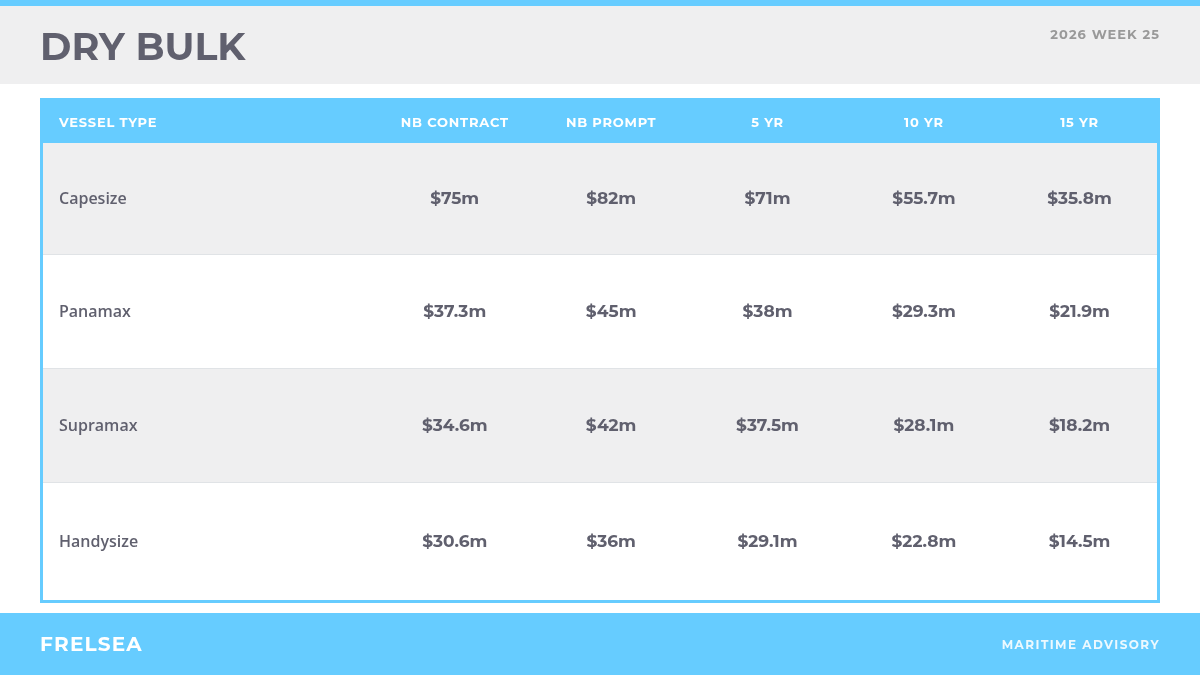
Capesize activity returned after a quiet spell. A pair of 2012 and 2013-built sisters of around 205,000 dwt sold en bloc at 88 million dollars, equivalent to 44 million dollars each, while a third sister of the same series changed hands separately. A 2020-built Capesize of about 183,000 dwt was sold off market at a level in excess of 66 million dollars.
Mid-size dry bulk saw the heaviest turnover. Two 2011 and 2012-built Post Panamax units of around 93,000 dwt were committed at 15 to 15.6 million dollars, one to UAE buyers and one to Greek interests for October delivery. In the Kamsarmax size, a 2017-built Japanese unit went to UAE buyers at 32 million dollars through an auction sale, and a 2023-built resale of about 85,000 dwt was taken by an established owner at 37.5 million dollars. Two 2026-built Ultramax resales of around 63,800 dwt were reported at 37.5 million dollars each. Panamax tonnage was thinner, with a 2011-built unit at 13 million dollars and a 2005-built vessel at 11.5 million dollars, both to Chinese buyers.
The Supramax and Handysize sizes were the most active part of the dry market by deal count. Supramax sales ranged from a 2013-built unit at 19.2 million dollars down to older 2008 and 2009-built tonnage in the 12 to 13 million dollar range, with one 2013-built vessel sold to Gulf interests at around 16 million dollars. Handysize turnover was broad, spanning a 2015-built unit at 18 million dollars and a 2014-built ship at 17 million dollars through to 2004 and 2008-built tonnage at 7 to 9 million dollars. Newbuilding interest in dry bulk also firmed, with one owner doubling an existing Newcastlemax order to eight units of around 210,000 dwt at 73 million dollars each, and further 82,000 dwt bulker contracts placed at Chinese yards at 37 million dollars.
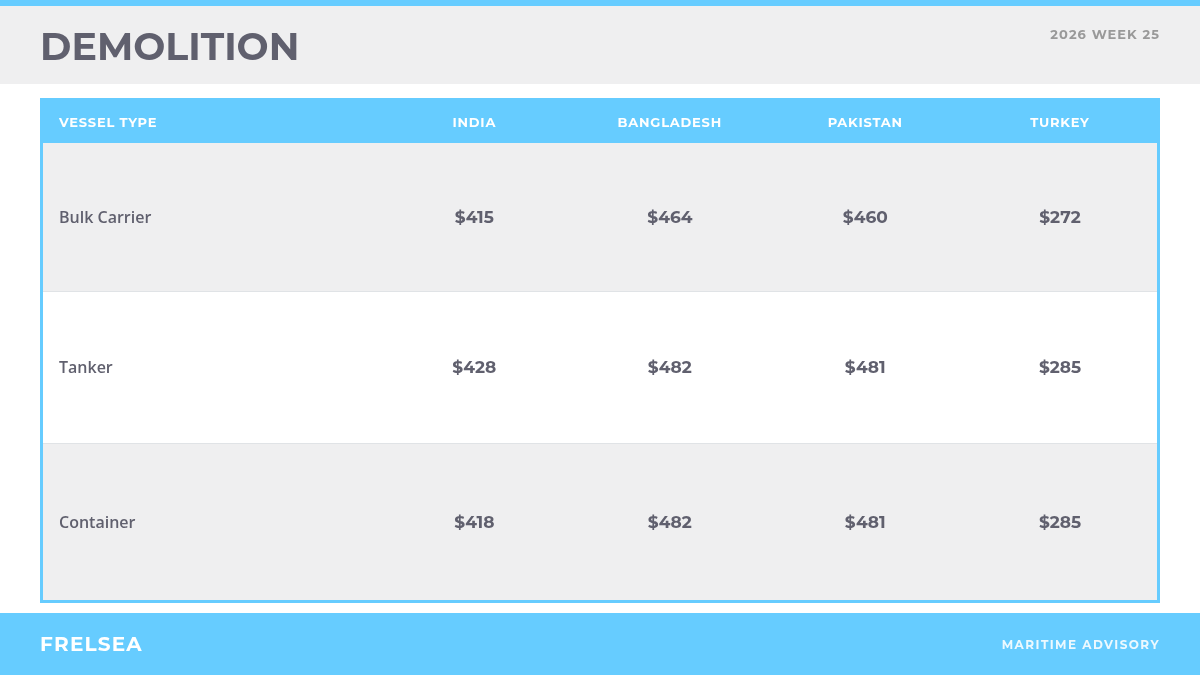
The recycling market stayed broadly firm across the subcontinent despite the onset of the monsoon. India was the softest of the main destinations, weighed by the rainy season and limited local buying, although a stronger rupee and a pick-up in arriving tonnage offered some support after a slow May. Bangladesh corrected lower by around 25 dollars per light ton as budget concerns eased following a national budget that raised value added tax, while Pakistan held at firm levels before easing as the global ceasefire and falling crude unwound the premium that had built up while the Strait of Hormuz was closed. Turkey softened further on thin demand and the seasonal summer slowdown.
The reopening of the Strait of Hormuz and the lifting of United States sanctions on Iranian oil framed sentiment, raising the prospect that ageing tonnage held out of the region for some eleven weeks could be released for recycling, though the timing and volume remain uncertain and any effect on scrap supply will take months to materialise. Confirmed sales were limited. A 1997-built bulk carrier of around 9,500 light tons was committed to India, and a 2004-built general cargo vessel of about 1,540 light tons was delivered to Bangladesh.