Secondhand activity in Week 33 concentrated on modern tanker tonnage and a broad spread of dry bulk sizes, while recycling prices in Pakistan moved sharply higher.
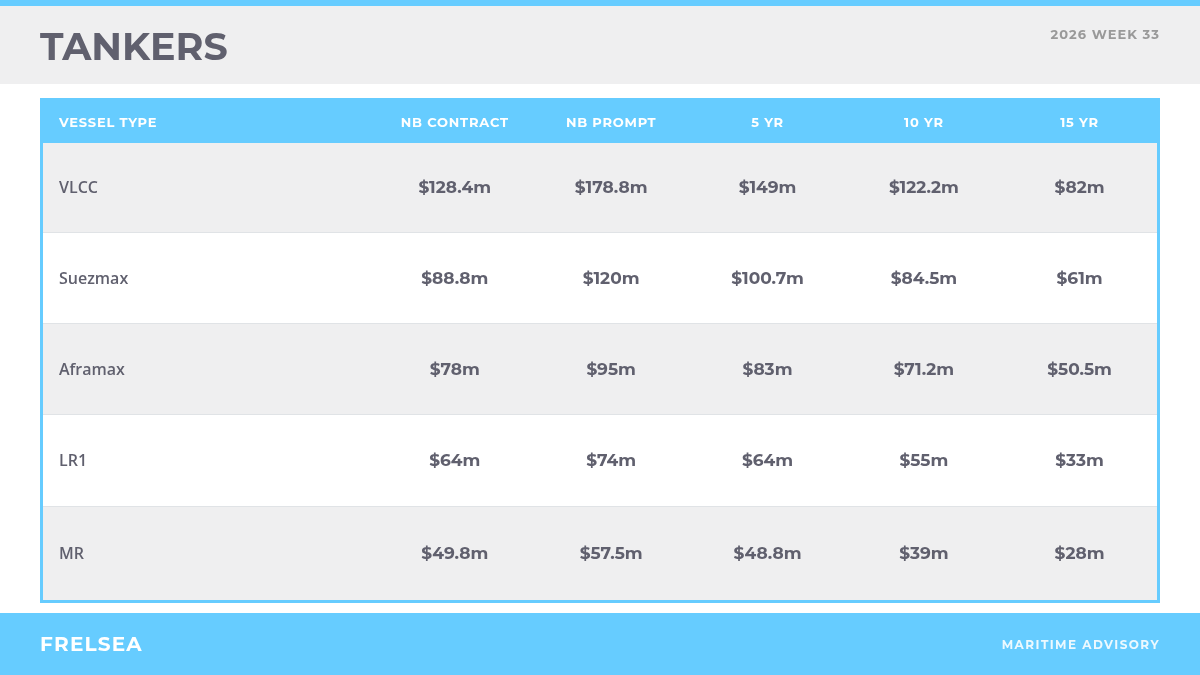
The largest reported transaction of the week was in the Suezmax sector. The 157,077 dwt “Bristol”, built at Hyundai Samho in 2024, was acquired by Naftomar for USD 123 million basis delivery in November and December 2026. The 158,425 dwt “Sonangol Namibe”, built at Daewoo in 2007, changed hands at USD 49.7 million, a gap of USD 73 million between two crude carriers of similar size seventeen years apart.
Product tanker activity centred on resales and older tonnage. The scrubber fitted sisters “On Promise” and “On Prosper”, both 50,100 dwt and completing at Hyundai Mipo in 2026, were sold at USD 58.5 million each, or USD 117 million for the pair, basis delivery between August and October 2026. Older units cleared at a wide discount. The stainless steel “Atlantic Eagle” of 47,128 dwt, built at the same yard in 2007, was reported at USD 18 million and the 46,818 dwt “Mumbai” of 2003 at USD 10.35 million. Greek buyers acquired the 39,756 dwt “Maersk Kate”, built at Guangzhou Shipyard in 2010, for USD 21.9 million.
Smaller specialised tonnage held firm value. The scrubber fitted, stainless steel “Damsgaard” of 19,998 dwt and “Loevstakken” of 19,996 dwt, built at Fukuoka in 2016 and 2015, were reported at USD 32.9 million each, a level set by the narrow supply of chemical capable tonnage.
Newbuilding contracting remained heavy. Minsheng Financial Leasing ordered four 306,000 dwt VLCCs at Jiangsu New Hantong at approximately USD 125 million each against a time charter to Clearlake, and Dynacom placed four at Hengli at around USD 122 million each. Minsheng also booked five 49,900 dwt tankers at Guangzhou Shipyard International at around USD 45.5 million each on long charter to Shell, taking Shell’s order book for the type in China to eleven vessels.
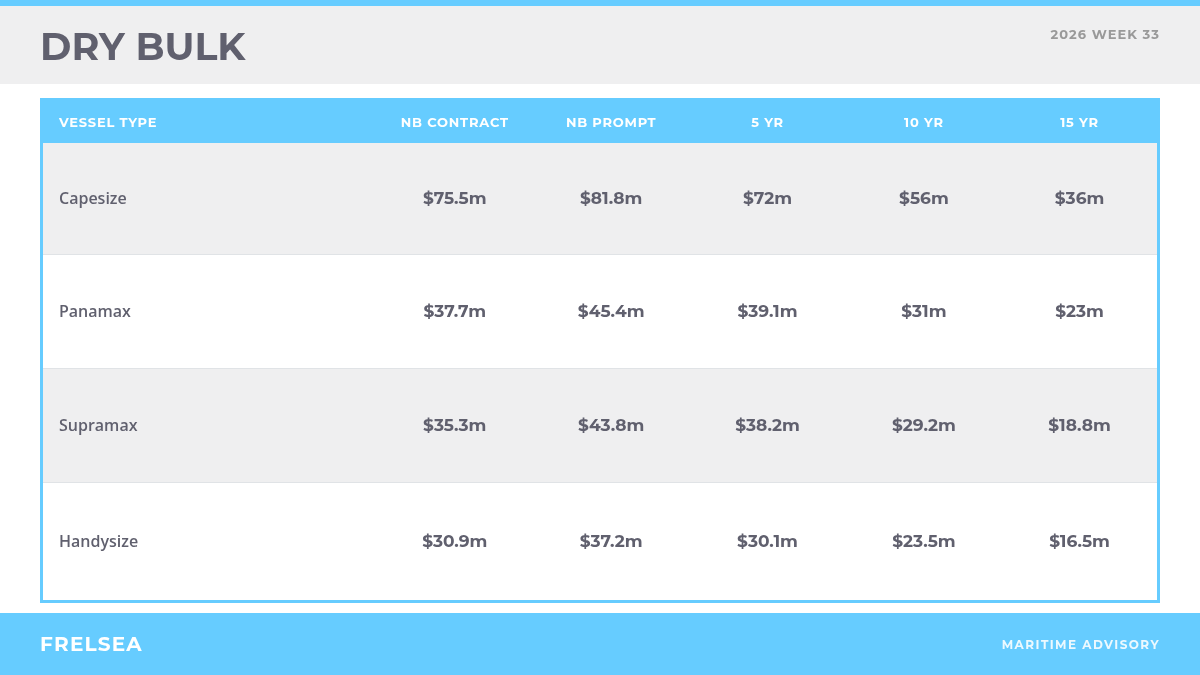
Some 496 bulk carriers changed hands in the first seven months of 2026 against 428 in the same period of 2025, an increase of 16 percent. Handysize and Supramax units accounted for close to 45 percent of that total. Ultramax sales rose from 33 to 60 and Post-Panamax from 11 to 32, while Panamax fell from 56 to 32.
Capesize activity covered both ends of the age curve. The 182,263 dwt “Princess Eternity” of 2022 was sold at USD 78 million on a three year bareboat hire purchase, while the scrubber fitted “Jian Fa” of 175,085 dwt, built in 2004, was reported at USD 18.5 million.
The Kamsarmax and Panamax sectors carried the week’s deal count. Indian buyers acquired the 81,886 dwt “Presinge”, built at Tsuneishi Zhoushan in 2015, at USD 31 million, while the 81,895 dwt “BBG Wuzhou” of 2016 from the same yard sold at USD 29 million through an online auction. The 82,174 dwt “Efraim A” of 2010 was reported at USD 20 million, and the 73,592 dwt “Kartini Samudra” of 2004 went to Chinese buyers at USD 7.8 million.
Geared tonnage traded across a wide range. Greek buyers acquired the 61,171 dwt “Gramos”, built at NACKS in 2019, at USD 34.5 million, and the 58,716 dwt “Global Oriole” of 2012 from the same yard at USD 19.5 million. Chinese buyers took the 63,500 dwt “Amaryllis” of 2013 at USD 24 million. Older units cleared lower, with the 57,269 dwt “Lila Mundra” of 2009 at USD 12.5 million and the 36,009 dwt Handysize “Amira Diana” of 2010 at USD 11.5 million.
Chinese buyers acquired 98 bulk carriers over the seven month period, down from 157 a year earlier, while Greek owners remained the largest sellers with 100 disposals. Contracting stayed active, led by COSCO Shipping Development with twelve 212,000 dwt units at Nantong Xiangyu and Shanghai Waigaoqiao at approximately USD 78 million each for delivery between 2028 and 2032.
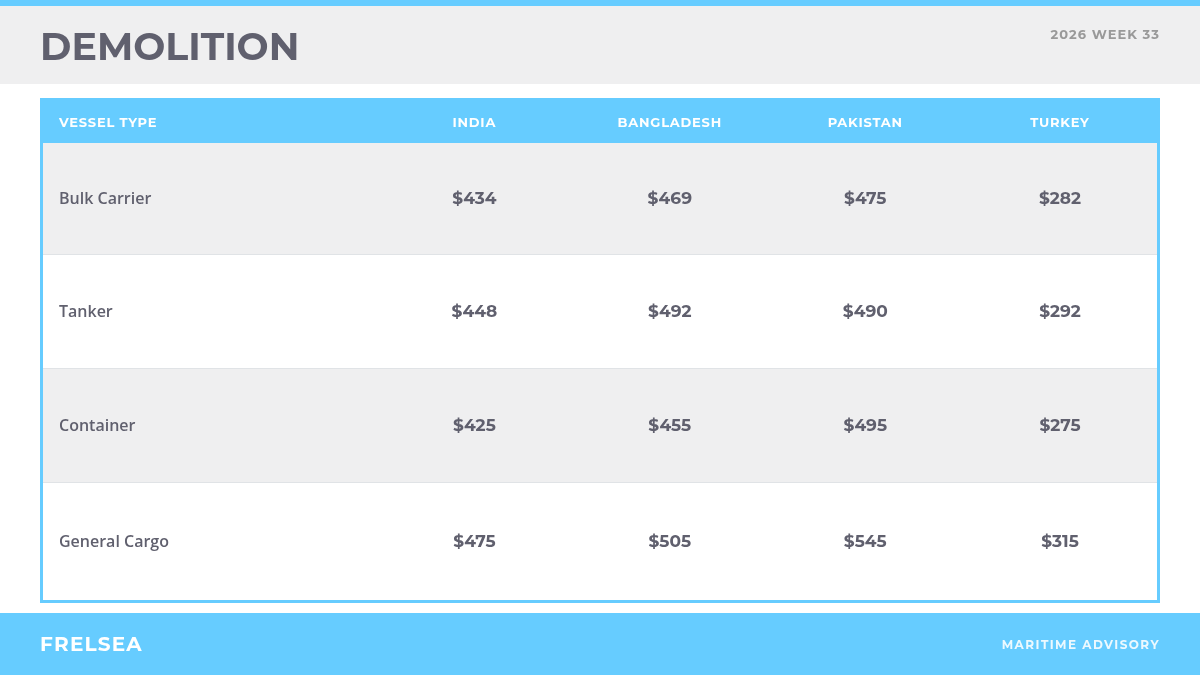
Pakistan set the pace. Offers at Gaddani spiked, with recyclers bidding aggressively for any available candidate tonnage. The 1997 built bulk carrier “Maria” of 6,182 ldt was delivered at USD 532 per ldt, and the 2001 built tanker “Green Stars” of 8,274 ldt was committed at USD 500 per ldt as is Belawan, Indonesia for redelivery Gaddani. The driver is a shortage of meltable material after overland steel and scrap imports from Iran fell sharply, pushing domestic mills to lean on shipbreakers for feedstock. Taxation changes and the renewed Hong Kong Convention certification process added to the bidding, though hot rolled coil importing at around USD 560 per tonne may cap the momentum.
Bangladesh held steady with demand focused on larger tonnage, though a gap persists between buyer and seller ideas. Five recycling facilities secured conditional environmental approval, adding buying capacity. The local steel trade remains sluggish after an outage at the Maheshkhali floating terminal curbed gas supply and slowed output.
India continues to trade at a discount to its neighbours and has leaned into ro-pax units, reefers and sanctioned tonnage. Sanctioned vessels account for approximately 58 percent of tanker recycling sales this year, some 22 ships out of 38. Turkey stayed subdued, with the central bank raising its year end 2026 inflation forecast to 28 percent while holding the policy rate at 37 percent. The 1993 built tanker “Fuji” went to Bangladesh and the 1992 built bulk carrier “Brave Leader” of 5,031 ldt to Turkey, both at undisclosed levels.